Sign up. Be inspired. Get clicking.
What your venue's emissions data really means to corporate clients
23 September 2026
When a hotel hosts a corporate conference, the same emissions data means something different depending on who's asking, routine reporting for the venue, part of a Scope 3 footprint for the client. This article breaks down why that matters, what's actually driving an event's footprint, and how hotel and venue teams can answer corporate sustainability questions with precision instead of a vague claim.
One footprint, read two ways
When a hotel hosts a corporate conference, the venue's electricity, catering and waste numbers are just another line in its own operational reporting. Routine, internal, Scope 1 and Scope 2. For the corporate that booked the event, that exact same data is something else entirely: part of their Scope 3 footprint, emissions they're responsible for even though they don't control them directly. Same numbers, two different meanings, depending on who's asking.
The accounting quirk, explained plainly
Under the GHG Protocol, a client's spend on an event, venue hire, catering, the works, typically sits under Scope 3, Category 1: purchased goods and services. That's usually the largest single slice of a company's Scope 3 footprint.
Hotel stays specifically get slightly different treatment. They're only an optional line within Scope 3, Category 6 (business travel). That's starting to change: in the EU, a rule called ESRS E1 requires large companies to report this data once it's material, closing off the option to leave it out. Similar tightening is happening in other regions too, at different speeds, so "optional" is becoming a shrinking category rather than a safe default.
There's a real trap hiding here too. A hotel's own Scope 2 electricity accounting and a guest company's Category 6 accounting are separate calculations, covering separate reporting boundaries. Count both as if they're the same thing, and the numbers double up. None of this is obscure detail. It's exactly what determines whether a venue's answer holds up, or starts to look shaky under closer questions.
This is starting to affect real bookings
Corporate event briefs increasingly ask venues for emissions data before a booking is confirmed, not after. Research from ReadyBid on hotel RFPs found sustainability ownership is often genuinely fragmented. It can sit across sales, operations, procurement and finance, with no single team clearly accountable for the answer.
That combination, rising expectation paired with unclear ownership, is exactly why a venue that can answer quickly and confidently stands out. One that can't risk losing consideration before the conversation properly starts.

Why it's harder than one number
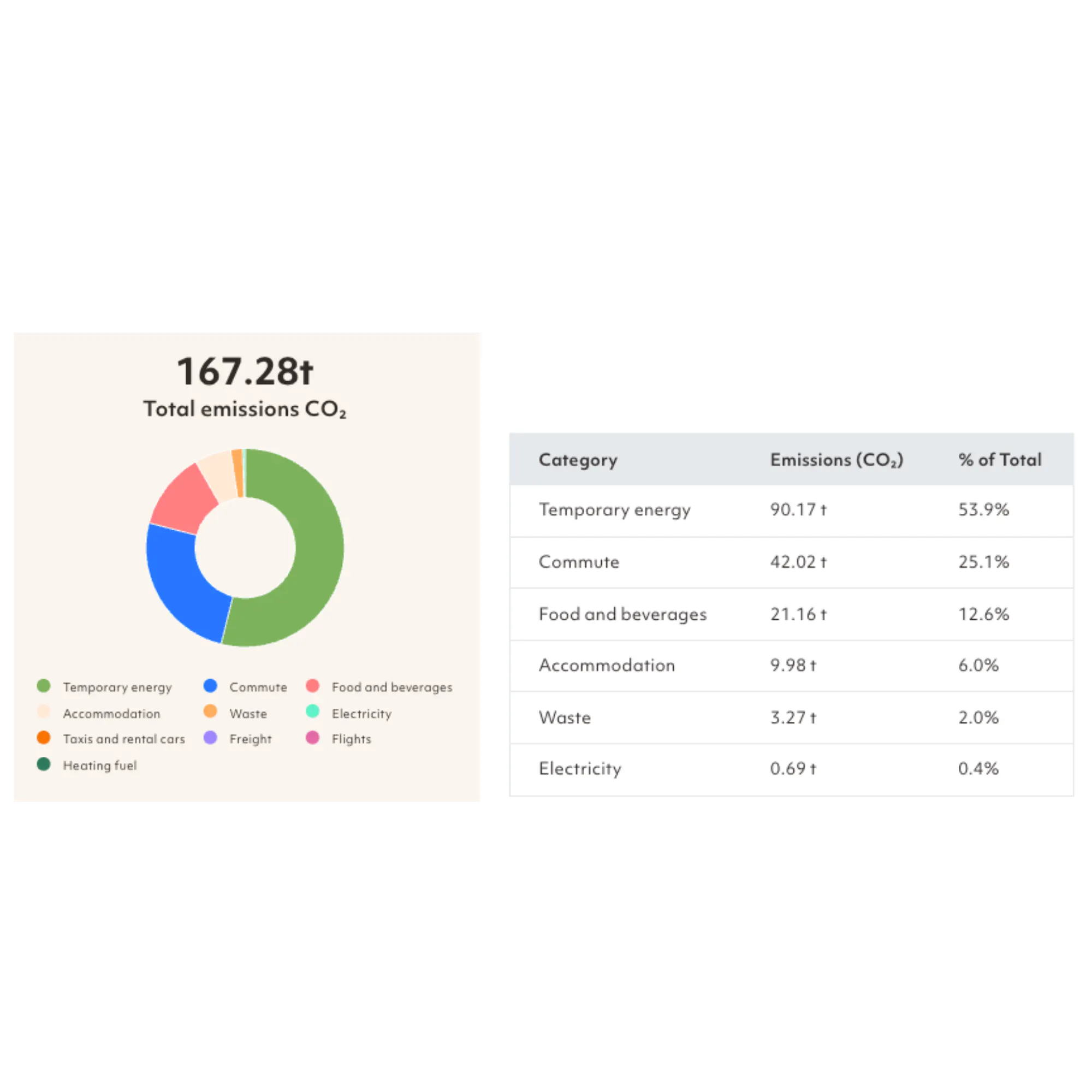
It's also not a question with one obvious answer. Analysis from Greenly and the Net Zero Carbon Events initiative suggests attendee travel typically makes up somewhere between 70% and 90% of a typical event's footprint. Venue energy itself, by comparison, is a relatively small slice (estimated at around 4% by the Climate Action Accelerator).
A credible answer has to account for electricity, fuel, waste, food and beverage, freight, travel and accommodation together, at very different scales. There's no single lever a venue can pull to fix the number in one move.
An answer that works for the venue too
This doesn't have to be just about ticking a compliance box. Framed as a transparent, itemised line in the event quote, a contribution becomes proof a client can use in their own reporting, not just a good-faith gesture. It also gives a venue's sales team something concrete to point to in a competitive pitch, rather than a vague claim buried in a brochure.
Precision over vague claims
A credible answer is specific, not sweeping: transparent, itemised, and independently certified. It's never a blanket claim like "carbon neutral" without the numbers to back it up. Precision is what makes the answer hold up in the first place.
Get in touch
CarbonClick partners with hotels and venues to help answer corporate clients' emissions questions clearly and confidently. Whether your team is already fielding this question or wants to be ready before it comes up, get in touch. We'd like to help.
186 Twilight Road
Clevedon, 2582
Auckland, New Zealand
info@carbonclick.com- -
- X
Subscribe now to stay up to date with CarbonClick, carbon offsetting and climate action.
By signing up you agree to our Privacy Policy.

NZBN: 9429047450356
© 2026 CarbonClick Limited