Sign up. Be inspired. Get clicking.
Offsets plus SAF CER: A smarter way to cut corporate travel emissions
3 December 2025
Airlines and their corporate clients face a shared challenge: managing Scope 3 emissions from business travel, those indirect emissions from fuel production, supply chains, and employee flights. High-quality offsets, funding verified projects like reforestation or renewable energy, have been a trusted way to tackle these. But what if you could go further? What if you could offer clients credible reductions in their reported emissions, alongside offsets, without needing sustainable aviation fuel (SAF) on every flight?
Sustainable Aviation Fuel Certificates of Environmental Reduction (SAF CER) make this possible. By retiring these certificates, airlines and corporates can claim verified reductions, up to 80% lower lifecycle emissions than fossil jet fuel, while using offsets for full coverage. It’s a simple, powerful mix: offsets for broad impact, SAF CER for in-sector progress. This strengthens corporate travel programs, helping clients meet strict reporting standards and showing real commitment to aviation’s decarbonisation.
Why SAF CER adds value to offsets
Offsets ensure every tonne is addressed through certified projects. SAF CER goes a step further, enabling Scope 3 reductions (categories 3, 4, and 6) under GHG Protocol and SBTi standards. Through a book-and-claim model, SAF’s environmental benefits are captured as certificates, which can be retired independently of the physical fuel. This lets corporates report lower business travel emissions, while airlines differentiate their offerings with a premium service.
For airlines, bundling SAF CER with offsets means clients get both offset receipts and reduction certificates. It’s an easy way to lower reported emissions now, while boosting SAF demand for the future.
For many corporates, purchasing SAF CER is about far more than compliance or checking a reporting box, it’s about genuine leadership. Early adopters frequently describe it as taking the first meaningful step on one of the hardest-to-abate sources of emissions, sending a clear market signal and encouraging others to follow.
They also recognise that every certificate retired today helps scale production, improves long-term supply security, and drives down the premium that SAF still carries. When airlines make SAF CER available, they hand their corporate clients both a verifiable Scope 3 reduction they can claim right now and a compelling narrative: they’re not just managing emissions, they’re actively accelerating aviation’s transition to a lower-carbon future.
Who can claim what
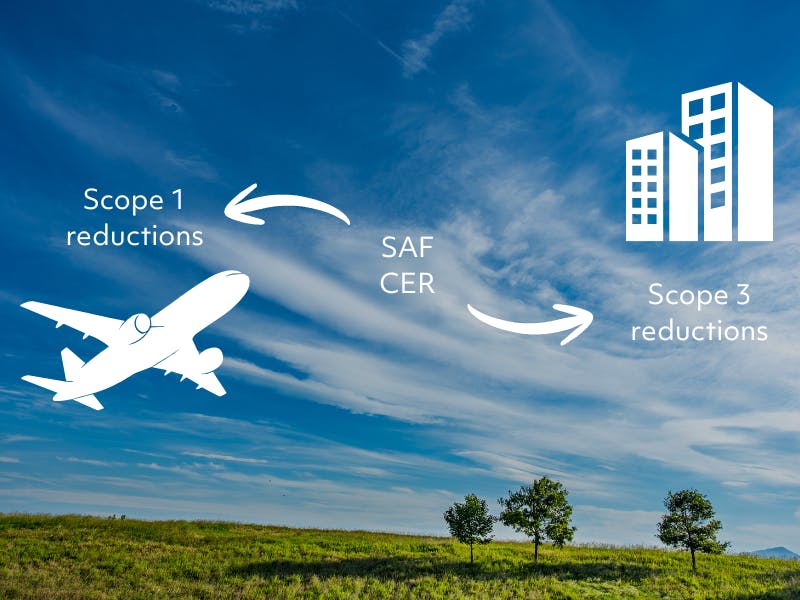
SAF CER allows clear, non-overlapping claims. For each tonne of SAF, separate attributes are generated: airlines can claim Scope 1 reductions (direct emissions from fuel combustion), while corporates claim Scope 3 reductions (indirect emissions from business travel). Verified tracking prevents double-counting, ensuring compliance with GHG Protocol and SBTi standards.
Why airlines should act: Growing SAF amid new rules
With SAF mandates rolling out globally, integrating SAF CER into corporate programs positions airlines as leaders. It drives SAF production and appeals to clients facing rising sustainability demands in RFPs and stakeholder expectations.
Real-world example: Microsoft’s approach
Microsoft pairs SAF CER with offsets to cut Scope 3 emissions from business travel. By funding SAF production in the UK and US, they claim reductions via certificates and use offsets for broader coverage. Airlines in these partnerships see stronger client loyalty from this dual approach.
Every flight counts
Decarbonisation takes time, but combining offsets with SAF CER delivers results now, transparently. For airlines, it’s a smart move: empower corporate clients with reductions they can claim, backed by offsets they trust.
186 Twilight Road
Clevedon, 2582
Auckland, New Zealand
info@carbonclick.com- -
- X
Subscribe now to stay up to date with CarbonClick, carbon offsetting and climate action.
By signing up you agree to our Privacy Policy.

NZBN: 9429047450356
© 2026 CarbonClick Limited